Live Online GMAT Prep Course
A 16-week live online GMAT group course: 11 weeks of Quantitative Reasoning, Verbal Reasoning and Data Insights lessons, then 5 weeks working through practice tests together. Lessons run on Saturdays and Sundays, 13:00–16:30 (Istanbul time).
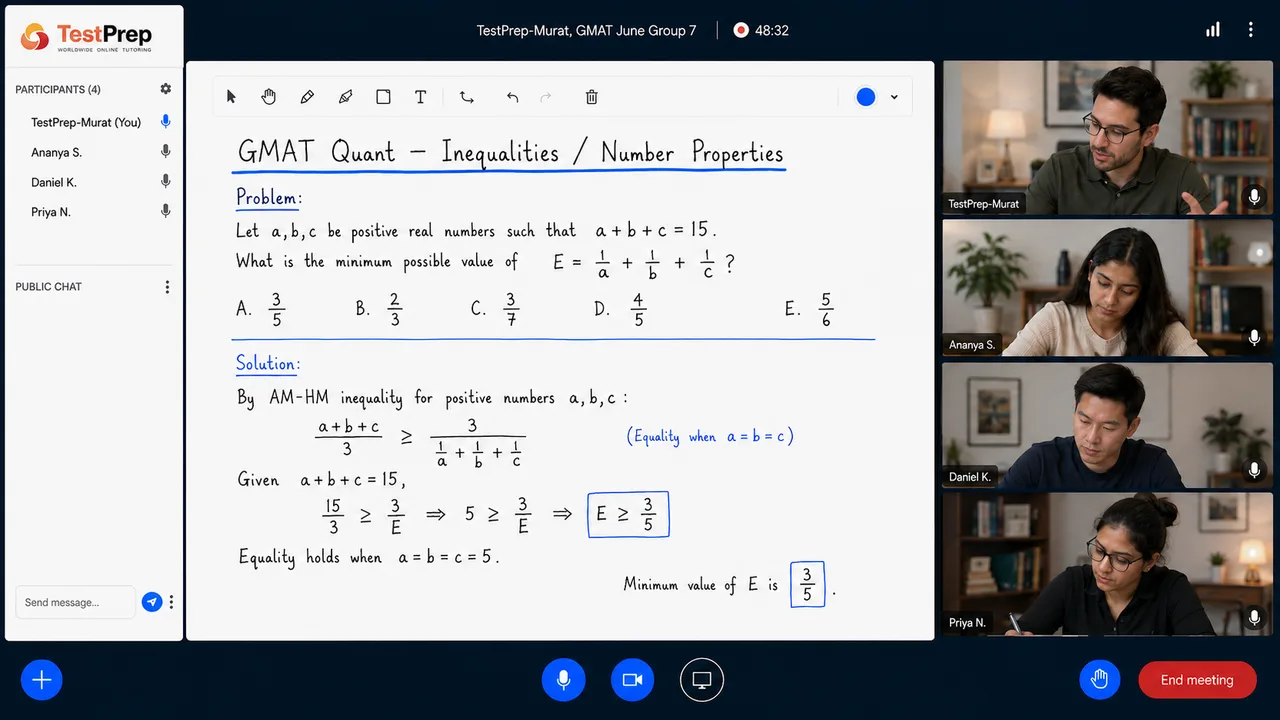
The short answer
Our GMAT preparation course is a live online programme that takes you through a set syllabus for all three sections of the exam: Quantitative Reasoning, Verbal Reasoning and Data Insights. The group course runs for 16 weeks, with 72 hours of live lessons on Saturdays and Sundays; private tutoring is shaped entirely around your level.
Who is it for?
How our GMAT preparation course works
Live topic lessons
62 lessons over 11 weeks, on Saturdays and Sundays, 13:00–16:30.
Homework and tracking
Homework, progress tracking in your dashboard and answers to your questions within 24 hours.
20 practice tests
They open on your account on the day of the last topic lesson.
Practice-test review
For the last 5 weeks, we go through the practice-test questions together on Sundays.
A typical week on the course
The learning carries on after the live lesson. Lessons, homework, your error log and practice-test reviews all feed into one another, so every week aims for progress you can measure.
Live lesson
We teach the week's main topic and work through the question types, the approach and the timing together.
Targeted homework
After each lesson you get question sets chosen for that topic, plus an error-log task.
Quick review
We sort your mistakes into gaps in understanding, timing and careless slips, and track the ones that keep coming back.
Practice-test review
Last 5 weeks: on Sundays we go through the practice-test questions together and close your remaining gaps.
Upcoming start dates
Each group takes 24 students, taught in classes of up to 6 grouped by level. Places are limited, so we recommend enrolling early.
GMAT group course
Starts 14 Nov 2026
- Enrolment deadline
- 11 November 2026
- First lesson
- 14 November 2026
- Last topic lesson
- 23 January 2027
- Review phase
- 31 January 2027 – 28 February 2027
- Length
- 16 weeks · 72 hours
- Days and times
- Sat + Sun 13:00–16:30
Not happy after the first week? 100% refund
GMAT group course
Starts 9 Jan 2027
- Enrolment deadline
- 6 January 2027
- First lesson
- 9 January 2027
- Last topic lesson
- 20 March 2027
- Review phase
- 28 March 2027 – 25 April 2027
- Length
- 16 weeks · 72 hours
- Days and times
- Sat + Sun 13:00–16:30
Not happy after the first week? 100% refund
GMAT group course
Starts 13 Feb 2027
- Enrolment deadline
- 10 February 2027
- First lesson
- 13 February 2027
- Last topic lesson
- 24 April 2027
- Review phase
- 2 May 2027 – 30 May 2027
- Length
- 16 weeks · 72 hours
- Days and times
- Sat + Sun 13:00–16:30
Not happy after the first week? 100% refund
Weekly Timetable
Saturday
- 13:00–14:00
- Quantitative Reasoning + Data Insights
- 14:15–15:15
- Quantitative Reasoning + Data Insights
- 15:30–16:30
- Verbal Reasoning
Sunday
- 13:00–14:00
- Verbal Reasoning
- 14:15–15:15
- Quantitative Reasoning + Data Insights
- 15:30–16:30
- Weeks 1–6 Quantitative Reasoning + Data Insights · weeks 7–10 Verbal Reasoning
- First 10 weeks: weeks 1–6, 4 hrs Quantitative Reasoning + Data Insights and 2 hrs Verbal Reasoning; weeks 7–10, 3 + 3 hrs (six 60-minute lessons a week)
- Week 11 (Saturday): 1 hr Quantitative Reasoning + Data Insights and 1 hr Verbal Reasoning = 2 hrs
- Last 5 weeks (review): Sundays, 1 hr Quantitative Reasoning + Data Insights and 1 hr Verbal Reasoning = 2 hrs/week
All times are Türkiye time (UTC+3).
Lesson-by-Lesson Calendar
The date, time and topic of all 72 live lessons.
GMAT November 2026 lesson calendarClick to see the full calendarShowHide
| Date | Time | Topic |
|---|---|---|
| 14 Nov 2026 Sat | 13:00–14:00 | Quantitative Reasoning — Value, Order, and Factors (1/6) |
| 14 Nov 2026 Sat | 14:15–15:15 | Quantitative Reasoning — Value, Order, and Factors (2/6) |
| 14 Nov 2026 Sat | 15:30–16:30 | Verbal Reasoning — Critical Reasoning (1/13) |
| 15 Nov 2026 Sun | 13:00–14:00 | Verbal Reasoning — Reading Comprehension (1/12) |
| 15 Nov 2026 Sun | 14:15–15:15 | Quantitative Reasoning — Value, Order, and Factors (3/6) |
| 15 Nov 2026 Sun | 15:30–16:30 | Quantitative Reasoning — Value, Order, and Factors (4/6) |
| 21 Nov 2026 Sat | 13:00–14:00 | Quantitative Reasoning — Value, Order, and Factors (5/6) |
| 21 Nov 2026 Sat | 14:15–15:15 | Quantitative Reasoning — Value, Order, and Factors (6/6) |
| 21 Nov 2026 Sat | 15:30–16:30 | Verbal Reasoning — Critical Reasoning (2/13) |
| 22 Nov 2026 Sun | 13:00–14:00 | Verbal Reasoning — Reading Comprehension (2/12) |
| 22 Nov 2026 Sun | 14:15–15:15 | Quantitative Reasoning — Algebra, Equalities, and Inequalities (1/7) |
| 22 Nov 2026 Sun | 15:30–16:30 | Quantitative Reasoning — Algebra, Equalities, and Inequalities (2/7) |
| 28 Nov 2026 Sat | 13:00–14:00 | Quantitative Reasoning — Algebra, Equalities, and Inequalities (3/7) |
| 28 Nov 2026 Sat | 14:15–15:15 | Quantitative Reasoning — Algebra, Equalities, and Inequalities (4/7) |
| 28 Nov 2026 Sat | 15:30–16:30 | Verbal Reasoning — Critical Reasoning (3/13) |
| 29 Nov 2026 Sun | 13:00–14:00 | Verbal Reasoning — Reading Comprehension (3/12) |
| 29 Nov 2026 Sun | 14:15–15:15 | Quantitative Reasoning — Algebra, Equalities, and Inequalities (5/7) |
| 29 Nov 2026 Sun | 15:30–16:30 | Quantitative Reasoning — Algebra, Equalities, and Inequalities (6/7) |
| 5 Dec 2026 Sat | 13:00–14:00 | Quantitative Reasoning — Algebra, Equalities, and Inequalities (7/7) |
| 5 Dec 2026 Sat | 14:15–15:15 | Quantitative Reasoning — Rates, Ratios, and Percents (1/6) |
| 5 Dec 2026 Sat | 15:30–16:30 | Verbal Reasoning — Critical Reasoning (4/13) |
| 6 Dec 2026 Sun | 13:00–14:00 | Verbal Reasoning — Reading Comprehension (4/12) |
| 6 Dec 2026 Sun | 14:15–15:15 | Quantitative Reasoning — Rates, Ratios, and Percents (2/6) |
| 6 Dec 2026 Sun | 15:30–16:30 | Quantitative Reasoning — Rates, Ratios, and Percents (3/6) |
| 12 Dec 2026 Sat | 13:00–14:00 | Quantitative Reasoning — Rates, Ratios, and Percents (4/6) |
| 12 Dec 2026 Sat | 14:15–15:15 | Quantitative Reasoning — Rates, Ratios, and Percents (5/6) |
| 12 Dec 2026 Sat | 15:30–16:30 | Verbal Reasoning — Critical Reasoning (5/13) |
| 13 Dec 2026 Sun | 13:00–14:00 | Verbal Reasoning — Reading Comprehension (5/12) |
| 13 Dec 2026 Sun | 14:15–15:15 | Quantitative Reasoning — Rates, Ratios, and Percents (6/6) |
| 13 Dec 2026 Sun | 15:30–16:30 | Quantitative Reasoning — Statistics, Sets, Counting, Probability, Estimation, and Series (1/6) |
| 19 Dec 2026 Sat | 13:00–14:00 | Quantitative Reasoning — Statistics, Sets, Counting, Probability, Estimation, and Series (2/6) |
| 19 Dec 2026 Sat | 14:15–15:15 | Quantitative Reasoning — Statistics, Sets, Counting, Probability, Estimation, and Series (3/6) |
| 19 Dec 2026 Sat | 15:30–16:30 | Verbal Reasoning — Critical Reasoning (6/13) |
| 20 Dec 2026 Sun | 13:00–14:00 | Verbal Reasoning — Reading Comprehension (6/12) |
| 20 Dec 2026 Sun | 14:15–15:15 | Quantitative Reasoning — Statistics, Sets, Counting, Probability, Estimation, and Series (4/6) |
| 20 Dec 2026 Sun | 15:30–16:30 | Quantitative Reasoning — Statistics, Sets, Counting, Probability, Estimation, and Series (5/6) |
| 26 Dec 2026 Sat | 13:00–14:00 | Quantitative Reasoning — Statistics, Sets, Counting, Probability, Estimation, and Series (6/6) |
| 26 Dec 2026 Sat | 14:15–15:15 | Data Insights — Data Sufficiency (1/4) |
| 26 Dec 2026 Sat | 15:30–16:30 | Verbal Reasoning — Critical Reasoning (7/13) |
| 27 Dec 2026 Sun | 13:00–14:00 | Verbal Reasoning — Reading Comprehension (7/12) |
| 27 Dec 2026 Sun | 14:15–15:15 | Data Insights — Data Sufficiency (2/4) |
| 27 Dec 2026 Sun | 15:30–16:30 | Verbal Reasoning — Critical Reasoning (8/13) |
| 2 Jan 2027 Sat | 13:00–14:00 | Data Insights — Data Sufficiency (3/4) |
| 2 Jan 2027 Sat | 14:15–15:15 | Data Insights — Data Sufficiency (4/4) |
| 2 Jan 2027 Sat | 15:30–16:30 | Verbal Reasoning — Reading Comprehension (8/12) |
| 3 Jan 2027 Sun | 13:00–14:00 | Verbal Reasoning — Critical Reasoning (9/13) |
| 3 Jan 2027 Sun | 14:15–15:15 | Data Insights — Table Analysis (1/2) |
| 3 Jan 2027 Sun | 15:30–16:30 | Verbal Reasoning — Reading Comprehension (9/12) |
| 9 Jan 2027 Sat | 13:00–14:00 | Data Insights — Table Analysis (2/2) |
| 9 Jan 2027 Sat | 14:15–15:15 | Data Insights — Graphics Interpretation (1/2) |
| 9 Jan 2027 Sat | 15:30–16:30 | Verbal Reasoning — Critical Reasoning (10/13) |
| 10 Jan 2027 Sun | 13:00–14:00 | Verbal Reasoning — Reading Comprehension (10/12) |
| 10 Jan 2027 Sun | 14:15–15:15 | Data Insights — Graphics Interpretation (2/2) |
| 10 Jan 2027 Sun | 15:30–16:30 | Verbal Reasoning — Critical Reasoning (11/13) |
| 16 Jan 2027 Sat | 13:00–14:00 | Data Insights — Two-Part Analysis (1/2) |
| 16 Jan 2027 Sat | 14:15–15:15 | Data Insights — Two-Part Analysis (2/2) |
| 16 Jan 2027 Sat | 15:30–16:30 | Verbal Reasoning — Reading Comprehension (11/12) |
| 17 Jan 2027 Sun | 13:00–14:00 | Verbal Reasoning — Critical Reasoning (12/13) |
| 17 Jan 2027 Sun | 14:15–15:15 | Data Insights — Multi-Source Reasoning (1/2) |
| 17 Jan 2027 Sun | 15:30–16:30 | Verbal Reasoning — Reading Comprehension (12/12) |
| 23 Jan 2027 Sat | 13:00–14:00 | Data Insights — Multi-Source Reasoning (2/2) |
| 23 Jan 2027 Sat | 14:15–15:15 | Verbal Reasoning — Critical Reasoning (13/13) |
| 31 Jan 2027 Sun | 13:00–14:00 | Practice-test review — Quantitative Reasoning and Data Insights (1/5) |
| 31 Jan 2027 Sun | 14:15–15:15 | Practice-test review — Verbal Reasoning (1/5) |
| 7 Feb 2027 Sun | 13:00–14:00 | Practice-test review — Quantitative Reasoning and Data Insights (2/5) |
| 7 Feb 2027 Sun | 14:15–15:15 | Practice-test review — Verbal Reasoning (2/5) |
| 14 Feb 2027 Sun | 13:00–14:00 | Practice-test review — Quantitative Reasoning and Data Insights (3/5) |
| 14 Feb 2027 Sun | 14:15–15:15 | Practice-test review — Verbal Reasoning (3/5) |
| 21 Feb 2027 Sun | 13:00–14:00 | Practice-test review — Quantitative Reasoning and Data Insights (4/5) |
| 21 Feb 2027 Sun | 14:15–15:15 | Practice-test review — Verbal Reasoning (4/5) |
| 28 Feb 2027 Sun | 13:00–14:00 | Practice-test review — Quantitative Reasoning and Data Insights (5/5) |
| 28 Feb 2027 Sun | 14:15–15:15 | Practice-test review — Verbal Reasoning (5/5) |
- Every lesson is 60 minutes. Weeks 1–6 have four Quantitative Reasoning / Data Insights lessons and two Verbal Reasoning lessons a weekend; weeks 7–10 have three of each.
- Data Insights is taught by the maths teacher who teaches Quantitative Reasoning: 37 lessons in all. The Verbal Reasoning teacher has 25.
- In week 11 both lessons are on Saturday; the last five weeks are practice-test reviews on Sundays.
GMAT January 2027 lesson calendarClick to see the full calendarShowHide
| Date | Time | Topic |
|---|---|---|
| 9 Jan 2027 Sat | 13:00–14:00 | Quantitative Reasoning — Value, Order, and Factors (1/6) |
| 9 Jan 2027 Sat | 14:15–15:15 | Quantitative Reasoning — Value, Order, and Factors (2/6) |
| 9 Jan 2027 Sat | 15:30–16:30 | Verbal Reasoning — Critical Reasoning (1/13) |
| 10 Jan 2027 Sun | 13:00–14:00 | Verbal Reasoning — Reading Comprehension (1/12) |
| 10 Jan 2027 Sun | 14:15–15:15 | Quantitative Reasoning — Value, Order, and Factors (3/6) |
| 10 Jan 2027 Sun | 15:30–16:30 | Quantitative Reasoning — Value, Order, and Factors (4/6) |
| 16 Jan 2027 Sat | 13:00–14:00 | Quantitative Reasoning — Value, Order, and Factors (5/6) |
| 16 Jan 2027 Sat | 14:15–15:15 | Quantitative Reasoning — Value, Order, and Factors (6/6) |
| 16 Jan 2027 Sat | 15:30–16:30 | Verbal Reasoning — Critical Reasoning (2/13) |
| 17 Jan 2027 Sun | 13:00–14:00 | Verbal Reasoning — Reading Comprehension (2/12) |
| 17 Jan 2027 Sun | 14:15–15:15 | Quantitative Reasoning — Algebra, Equalities, and Inequalities (1/7) |
| 17 Jan 2027 Sun | 15:30–16:30 | Quantitative Reasoning — Algebra, Equalities, and Inequalities (2/7) |
| 23 Jan 2027 Sat | 13:00–14:00 | Quantitative Reasoning — Algebra, Equalities, and Inequalities (3/7) |
| 23 Jan 2027 Sat | 14:15–15:15 | Quantitative Reasoning — Algebra, Equalities, and Inequalities (4/7) |
| 23 Jan 2027 Sat | 15:30–16:30 | Verbal Reasoning — Critical Reasoning (3/13) |
| 24 Jan 2027 Sun | 13:00–14:00 | Verbal Reasoning — Reading Comprehension (3/12) |
| 24 Jan 2027 Sun | 14:15–15:15 | Quantitative Reasoning — Algebra, Equalities, and Inequalities (5/7) |
| 24 Jan 2027 Sun | 15:30–16:30 | Quantitative Reasoning — Algebra, Equalities, and Inequalities (6/7) |
| 30 Jan 2027 Sat | 13:00–14:00 | Quantitative Reasoning — Algebra, Equalities, and Inequalities (7/7) |
| 30 Jan 2027 Sat | 14:15–15:15 | Quantitative Reasoning — Rates, Ratios, and Percents (1/6) |
| 30 Jan 2027 Sat | 15:30–16:30 | Verbal Reasoning — Critical Reasoning (4/13) |
| 31 Jan 2027 Sun | 13:00–14:00 | Verbal Reasoning — Reading Comprehension (4/12) |
| 31 Jan 2027 Sun | 14:15–15:15 | Quantitative Reasoning — Rates, Ratios, and Percents (2/6) |
| 31 Jan 2027 Sun | 15:30–16:30 | Quantitative Reasoning — Rates, Ratios, and Percents (3/6) |
| 6 Feb 2027 Sat | 13:00–14:00 | Quantitative Reasoning — Rates, Ratios, and Percents (4/6) |
| 6 Feb 2027 Sat | 14:15–15:15 | Quantitative Reasoning — Rates, Ratios, and Percents (5/6) |
| 6 Feb 2027 Sat | 15:30–16:30 | Verbal Reasoning — Critical Reasoning (5/13) |
| 7 Feb 2027 Sun | 13:00–14:00 | Verbal Reasoning — Reading Comprehension (5/12) |
| 7 Feb 2027 Sun | 14:15–15:15 | Quantitative Reasoning — Rates, Ratios, and Percents (6/6) |
| 7 Feb 2027 Sun | 15:30–16:30 | Quantitative Reasoning — Statistics, Sets, Counting, Probability, Estimation, and Series (1/6) |
| 13 Feb 2027 Sat | 13:00–14:00 | Quantitative Reasoning — Statistics, Sets, Counting, Probability, Estimation, and Series (2/6) |
| 13 Feb 2027 Sat | 14:15–15:15 | Quantitative Reasoning — Statistics, Sets, Counting, Probability, Estimation, and Series (3/6) |
| 13 Feb 2027 Sat | 15:30–16:30 | Verbal Reasoning — Critical Reasoning (6/13) |
| 14 Feb 2027 Sun | 13:00–14:00 | Verbal Reasoning — Reading Comprehension (6/12) |
| 14 Feb 2027 Sun | 14:15–15:15 | Quantitative Reasoning — Statistics, Sets, Counting, Probability, Estimation, and Series (4/6) |
| 14 Feb 2027 Sun | 15:30–16:30 | Quantitative Reasoning — Statistics, Sets, Counting, Probability, Estimation, and Series (5/6) |
| 20 Feb 2027 Sat | 13:00–14:00 | Quantitative Reasoning — Statistics, Sets, Counting, Probability, Estimation, and Series (6/6) |
| 20 Feb 2027 Sat | 14:15–15:15 | Data Insights — Data Sufficiency (1/4) |
| 20 Feb 2027 Sat | 15:30–16:30 | Verbal Reasoning — Critical Reasoning (7/13) |
| 21 Feb 2027 Sun | 13:00–14:00 | Verbal Reasoning — Reading Comprehension (7/12) |
| 21 Feb 2027 Sun | 14:15–15:15 | Data Insights — Data Sufficiency (2/4) |
| 21 Feb 2027 Sun | 15:30–16:30 | Verbal Reasoning — Critical Reasoning (8/13) |
| 27 Feb 2027 Sat | 13:00–14:00 | Data Insights — Data Sufficiency (3/4) |
| 27 Feb 2027 Sat | 14:15–15:15 | Data Insights — Data Sufficiency (4/4) |
| 27 Feb 2027 Sat | 15:30–16:30 | Verbal Reasoning — Reading Comprehension (8/12) |
| 28 Feb 2027 Sun | 13:00–14:00 | Verbal Reasoning — Critical Reasoning (9/13) |
| 28 Feb 2027 Sun | 14:15–15:15 | Data Insights — Table Analysis (1/2) |
| 28 Feb 2027 Sun | 15:30–16:30 | Verbal Reasoning — Reading Comprehension (9/12) |
| 6 Mar 2027 Sat | 13:00–14:00 | Data Insights — Table Analysis (2/2) |
| 6 Mar 2027 Sat | 14:15–15:15 | Data Insights — Graphics Interpretation (1/2) |
| 6 Mar 2027 Sat | 15:30–16:30 | Verbal Reasoning — Critical Reasoning (10/13) |
| 7 Mar 2027 Sun | 13:00–14:00 | Verbal Reasoning — Reading Comprehension (10/12) |
| 7 Mar 2027 Sun | 14:15–15:15 | Data Insights — Graphics Interpretation (2/2) |
| 7 Mar 2027 Sun | 15:30–16:30 | Verbal Reasoning — Critical Reasoning (11/13) |
| 13 Mar 2027 Sat | 13:00–14:00 | Data Insights — Two-Part Analysis (1/2) |
| 13 Mar 2027 Sat | 14:15–15:15 | Data Insights — Two-Part Analysis (2/2) |
| 13 Mar 2027 Sat | 15:30–16:30 | Verbal Reasoning — Reading Comprehension (11/12) |
| 14 Mar 2027 Sun | 13:00–14:00 | Verbal Reasoning — Critical Reasoning (12/13) |
| 14 Mar 2027 Sun | 14:15–15:15 | Data Insights — Multi-Source Reasoning (1/2) |
| 14 Mar 2027 Sun | 15:30–16:30 | Verbal Reasoning — Reading Comprehension (12/12) |
| 20 Mar 2027 Sat | 13:00–14:00 | Data Insights — Multi-Source Reasoning (2/2) |
| 20 Mar 2027 Sat | 14:15–15:15 | Verbal Reasoning — Critical Reasoning (13/13) |
| 28 Mar 2027 Sun | 13:00–14:00 | Practice-test review — Quantitative Reasoning and Data Insights (1/5) |
| 28 Mar 2027 Sun | 14:15–15:15 | Practice-test review — Verbal Reasoning (1/5) |
| 4 Apr 2027 Sun | 13:00–14:00 | Practice-test review — Quantitative Reasoning and Data Insights (2/5) |
| 4 Apr 2027 Sun | 14:15–15:15 | Practice-test review — Verbal Reasoning (2/5) |
| 11 Apr 2027 Sun | 13:00–14:00 | Practice-test review — Quantitative Reasoning and Data Insights (3/5) |
| 11 Apr 2027 Sun | 14:15–15:15 | Practice-test review — Verbal Reasoning (3/5) |
| 18 Apr 2027 Sun | 13:00–14:00 | Practice-test review — Quantitative Reasoning and Data Insights (4/5) |
| 18 Apr 2027 Sun | 14:15–15:15 | Practice-test review — Verbal Reasoning (4/5) |
| 25 Apr 2027 Sun | 13:00–14:00 | Practice-test review — Quantitative Reasoning and Data Insights (5/5) |
| 25 Apr 2027 Sun | 14:15–15:15 | Practice-test review — Verbal Reasoning (5/5) |
- Every lesson is 60 minutes. Weeks 1–6 have four Quantitative Reasoning / Data Insights lessons and two Verbal Reasoning lessons a weekend; weeks 7–10 have three of each.
- Data Insights is taught by the maths teacher who teaches Quantitative Reasoning: 37 lessons in all. The Verbal Reasoning teacher has 25.
- In week 11 both lessons are on Saturday; the last five weeks are practice-test reviews on Sundays.
GMAT February 2027 lesson calendarClick to see the full calendarShowHide
| Date | Time | Topic |
|---|---|---|
| 13 Feb 2027 Sat | 13:00–14:00 | Quantitative Reasoning — Value, Order, and Factors (1/6) |
| 13 Feb 2027 Sat | 14:15–15:15 | Quantitative Reasoning — Value, Order, and Factors (2/6) |
| 13 Feb 2027 Sat | 15:30–16:30 | Verbal Reasoning — Critical Reasoning (1/13) |
| 14 Feb 2027 Sun | 13:00–14:00 | Verbal Reasoning — Reading Comprehension (1/12) |
| 14 Feb 2027 Sun | 14:15–15:15 | Quantitative Reasoning — Value, Order, and Factors (3/6) |
| 14 Feb 2027 Sun | 15:30–16:30 | Quantitative Reasoning — Value, Order, and Factors (4/6) |
| 20 Feb 2027 Sat | 13:00–14:00 | Quantitative Reasoning — Value, Order, and Factors (5/6) |
| 20 Feb 2027 Sat | 14:15–15:15 | Quantitative Reasoning — Value, Order, and Factors (6/6) |
| 20 Feb 2027 Sat | 15:30–16:30 | Verbal Reasoning — Critical Reasoning (2/13) |
| 21 Feb 2027 Sun | 13:00–14:00 | Verbal Reasoning — Reading Comprehension (2/12) |
| 21 Feb 2027 Sun | 14:15–15:15 | Quantitative Reasoning — Algebra, Equalities, and Inequalities (1/7) |
| 21 Feb 2027 Sun | 15:30–16:30 | Quantitative Reasoning — Algebra, Equalities, and Inequalities (2/7) |
| 27 Feb 2027 Sat | 13:00–14:00 | Quantitative Reasoning — Algebra, Equalities, and Inequalities (3/7) |
| 27 Feb 2027 Sat | 14:15–15:15 | Quantitative Reasoning — Algebra, Equalities, and Inequalities (4/7) |
| 27 Feb 2027 Sat | 15:30–16:30 | Verbal Reasoning — Critical Reasoning (3/13) |
| 28 Feb 2027 Sun | 13:00–14:00 | Verbal Reasoning — Reading Comprehension (3/12) |
| 28 Feb 2027 Sun | 14:15–15:15 | Quantitative Reasoning — Algebra, Equalities, and Inequalities (5/7) |
| 28 Feb 2027 Sun | 15:30–16:30 | Quantitative Reasoning — Algebra, Equalities, and Inequalities (6/7) |
| 6 Mar 2027 Sat | 13:00–14:00 | Quantitative Reasoning — Algebra, Equalities, and Inequalities (7/7) |
| 6 Mar 2027 Sat | 14:15–15:15 | Quantitative Reasoning — Rates, Ratios, and Percents (1/6) |
| 6 Mar 2027 Sat | 15:30–16:30 | Verbal Reasoning — Critical Reasoning (4/13) |
| 7 Mar 2027 Sun | 13:00–14:00 | Verbal Reasoning — Reading Comprehension (4/12) |
| 7 Mar 2027 Sun | 14:15–15:15 | Quantitative Reasoning — Rates, Ratios, and Percents (2/6) |
| 7 Mar 2027 Sun | 15:30–16:30 | Quantitative Reasoning — Rates, Ratios, and Percents (3/6) |
| 13 Mar 2027 Sat | 13:00–14:00 | Quantitative Reasoning — Rates, Ratios, and Percents (4/6) |
| 13 Mar 2027 Sat | 14:15–15:15 | Quantitative Reasoning — Rates, Ratios, and Percents (5/6) |
| 13 Mar 2027 Sat | 15:30–16:30 | Verbal Reasoning — Critical Reasoning (5/13) |
| 14 Mar 2027 Sun | 13:00–14:00 | Verbal Reasoning — Reading Comprehension (5/12) |
| 14 Mar 2027 Sun | 14:15–15:15 | Quantitative Reasoning — Rates, Ratios, and Percents (6/6) |
| 14 Mar 2027 Sun | 15:30–16:30 | Quantitative Reasoning — Statistics, Sets, Counting, Probability, Estimation, and Series (1/6) |
| 20 Mar 2027 Sat | 13:00–14:00 | Quantitative Reasoning — Statistics, Sets, Counting, Probability, Estimation, and Series (2/6) |
| 20 Mar 2027 Sat | 14:15–15:15 | Quantitative Reasoning — Statistics, Sets, Counting, Probability, Estimation, and Series (3/6) |
| 20 Mar 2027 Sat | 15:30–16:30 | Verbal Reasoning — Critical Reasoning (6/13) |
| 21 Mar 2027 Sun | 13:00–14:00 | Verbal Reasoning — Reading Comprehension (6/12) |
| 21 Mar 2027 Sun | 14:15–15:15 | Quantitative Reasoning — Statistics, Sets, Counting, Probability, Estimation, and Series (4/6) |
| 21 Mar 2027 Sun | 15:30–16:30 | Quantitative Reasoning — Statistics, Sets, Counting, Probability, Estimation, and Series (5/6) |
| 27 Mar 2027 Sat | 13:00–14:00 | Quantitative Reasoning — Statistics, Sets, Counting, Probability, Estimation, and Series (6/6) |
| 27 Mar 2027 Sat | 14:15–15:15 | Data Insights — Data Sufficiency (1/4) |
| 27 Mar 2027 Sat | 15:30–16:30 | Verbal Reasoning — Critical Reasoning (7/13) |
| 28 Mar 2027 Sun | 13:00–14:00 | Verbal Reasoning — Reading Comprehension (7/12) |
| 28 Mar 2027 Sun | 14:15–15:15 | Data Insights — Data Sufficiency (2/4) |
| 28 Mar 2027 Sun | 15:30–16:30 | Verbal Reasoning — Critical Reasoning (8/13) |
| 3 Apr 2027 Sat | 13:00–14:00 | Data Insights — Data Sufficiency (3/4) |
| 3 Apr 2027 Sat | 14:15–15:15 | Data Insights — Data Sufficiency (4/4) |
| 3 Apr 2027 Sat | 15:30–16:30 | Verbal Reasoning — Reading Comprehension (8/12) |
| 4 Apr 2027 Sun | 13:00–14:00 | Verbal Reasoning — Critical Reasoning (9/13) |
| 4 Apr 2027 Sun | 14:15–15:15 | Data Insights — Table Analysis (1/2) |
| 4 Apr 2027 Sun | 15:30–16:30 | Verbal Reasoning — Reading Comprehension (9/12) |
| 10 Apr 2027 Sat | 13:00–14:00 | Data Insights — Table Analysis (2/2) |
| 10 Apr 2027 Sat | 14:15–15:15 | Data Insights — Graphics Interpretation (1/2) |
| 10 Apr 2027 Sat | 15:30–16:30 | Verbal Reasoning — Critical Reasoning (10/13) |
| 11 Apr 2027 Sun | 13:00–14:00 | Verbal Reasoning — Reading Comprehension (10/12) |
| 11 Apr 2027 Sun | 14:15–15:15 | Data Insights — Graphics Interpretation (2/2) |
| 11 Apr 2027 Sun | 15:30–16:30 | Verbal Reasoning — Critical Reasoning (11/13) |
| 17 Apr 2027 Sat | 13:00–14:00 | Data Insights — Two-Part Analysis (1/2) |
| 17 Apr 2027 Sat | 14:15–15:15 | Data Insights — Two-Part Analysis (2/2) |
| 17 Apr 2027 Sat | 15:30–16:30 | Verbal Reasoning — Reading Comprehension (11/12) |
| 18 Apr 2027 Sun | 13:00–14:00 | Verbal Reasoning — Critical Reasoning (12/13) |
| 18 Apr 2027 Sun | 14:15–15:15 | Data Insights — Multi-Source Reasoning (1/2) |
| 18 Apr 2027 Sun | 15:30–16:30 | Verbal Reasoning — Reading Comprehension (12/12) |
| 24 Apr 2027 Sat | 13:00–14:00 | Data Insights — Multi-Source Reasoning (2/2) |
| 24 Apr 2027 Sat | 14:15–15:15 | Verbal Reasoning — Critical Reasoning (13/13) |
| 2 May 2027 Sun | 13:00–14:00 | Practice-test review — Quantitative Reasoning and Data Insights (1/5) |
| 2 May 2027 Sun | 14:15–15:15 | Practice-test review — Verbal Reasoning (1/5) |
| 9 May 2027 Sun | 13:00–14:00 | Practice-test review — Quantitative Reasoning and Data Insights (2/5) |
| 9 May 2027 Sun | 14:15–15:15 | Practice-test review — Verbal Reasoning (2/5) |
| 16 May 2027 Sun | 13:00–14:00 | No lesson. The make-up lesson is on Saturday 22 May 2027 at 13:00. |
| 16 May 2027 Sun | 14:15–15:15 | No lesson. The make-up lesson is on Saturday 22 May 2027 at 14:15. |
| 22 May 2027 Sat | 13:00–14:00 | Practice-test review — Quantitative Reasoning and Data Insights (3/5) (make-up for 16 May 2027) |
| 22 May 2027 Sat | 14:15–15:15 | Practice-test review — Verbal Reasoning (3/5) (make-up for 16 May 2027) |
| 23 May 2027 Sun | 13:00–14:00 | Practice-test review — Quantitative Reasoning and Data Insights (4/5) |
| 23 May 2027 Sun | 14:15–15:15 | Practice-test review — Verbal Reasoning (4/5) |
| 30 May 2027 Sun | 13:00–14:00 | Practice-test review — Quantitative Reasoning and Data Insights (5/5) |
| 30 May 2027 Sun | 14:15–15:15 | Practice-test review — Verbal Reasoning (5/5) |
- Every lesson is 60 minutes. Weeks 1–6 have four Quantitative Reasoning / Data Insights lessons and two Verbal Reasoning lessons a weekend; weeks 7–10 have three of each.
- Data Insights is taught by the maths teacher who teaches Quantitative Reasoning: 37 lessons in all. The Verbal Reasoning teacher has 25.
- In week 11 both lessons are on Saturday; the last five weeks are practice-test reviews on Sundays.
What's Included
- 72 hours of live lessons over 16 weeks, 60 minutes each
- 37 hours of Quantitative Reasoning and Data Insights, 25 of Verbal Reasoning and 10 of practice-test review
- Fixed timetable: Saturdays and Sundays, 13:00–16:30 (Istanbul time)
- 24 places, taught in classes of up to 6 grouped by level
- 20 GMAT practice tests included
- GMAT Question Bank, full access included
- A personal study plan written by TestPrep
- Homework, with your progress tracked in your dashboard
- Questions answered within 24 hours
- Regular progress reports for parents
- Every lesson recorded, and watchable for 14 days
- All course materials included
The question bank opens on your account once the first week is over; the practice tests on the day of the last topic lesson.
Use practice tests and the question bank together
GMAT preparation works best when you measure your level with full-length tests, close the gaps in the question bank and repeat. Both tools follow the current GMAT format.
GMAT Practice Tests
Rehearse exam pacing with 21 tests
Take 20 full-length premium tests and 1 free diagnostic test that adapt to your answers question by question, as the GMAT does. Choose your section order, practise Review & Edit and get a detailed report every time.
- Question-adaptive engine
- Choose your section order
- Review & Edit practice
Start with the free diagnostic test
See the practice testsGMAT Question Bank
Fix weak topics with the question bank
Study topic by topic across Quant, Verbal and Data Insights with 10,724 questions, 45+ topics and 3 difficulty levels. Detailed solutions and performance reports show what you got wrong and why.
- Detailed solutions
- 45+ topics
- Performance reports
Try 30 free questions
See the question bankMeasure your level first
The free diagnostic test shows your starting point in each section.
Close gaps with the question bank
Work on the topics and question types you got wrong in focused sessions.
Take another test
Use your next full test to measure how your score, pacing and mistakes have changed.
Group course, private tutoring or hybrid?
All three options cover the same GMAT content. What changes is the pace and how closely the lessons are tailored to you. The hybrid option pairs the structure of the group course with the focus of one-to-one lessons.
| Feature | Group course | Private tutoring | Hybrid |
|---|---|---|---|
| Format | Small group (up to 6) | One-to-one | Group course plus one-to-one lessons |
| Syllabus | Full syllabus in a set order | Built around you | Group syllabus plus topics chosen for you |
| Pace | Set by the group | Flexible, set by you | Group pace with flexible extra lessons |
| Personalisation | Moderate | Highest | High |
| Focus on weak areas | Limited | Complete | In the one-to-one lessons |
| Best for | A steady routine on a budget | Fast, targeted progress | The full syllabus plus work on your gaps |
Hybrid GMAT preparation
With the hybrid option you follow the core syllabus in the group course and work on your weaker Quant, Verbal or Data Insights topics in one-to-one lessons. Backed by regular practice tests and individual feedback, it gives you the value of the group course with the focus of private tutoring.
AI Tutor talks you through the questions you got wrong
When your GMAT practice test ends, pick a mistake on your results page and the lesson starts. The tutor won't just read out the answer: it asks you, writes the steps on the board and lets you find where you went wrong.
- You work out loud
- No typing: you talk it through. Interrupt whenever you like, ask a question, or say “got it” and move on to the next one.
- It won't lead with the answer, or withhold it
- It asks you first and gives hints one step at a time when you're stuck. Ask for the answer and you get it; the “Show the answer” button is always there too.
Your first 2 mistakes are free (up to 10 minutes)
No card needed to try it, just your account.
Unused minutes stay on your account for your next practice tests.

Frequently Asked Questions
Let's plan your GMAT preparation together
Book a free intro call and we will work out together whether the group course or private tutoring suits you better.